

Ria Formosa: The Most Beautiful Natural Park in Southern Portugal

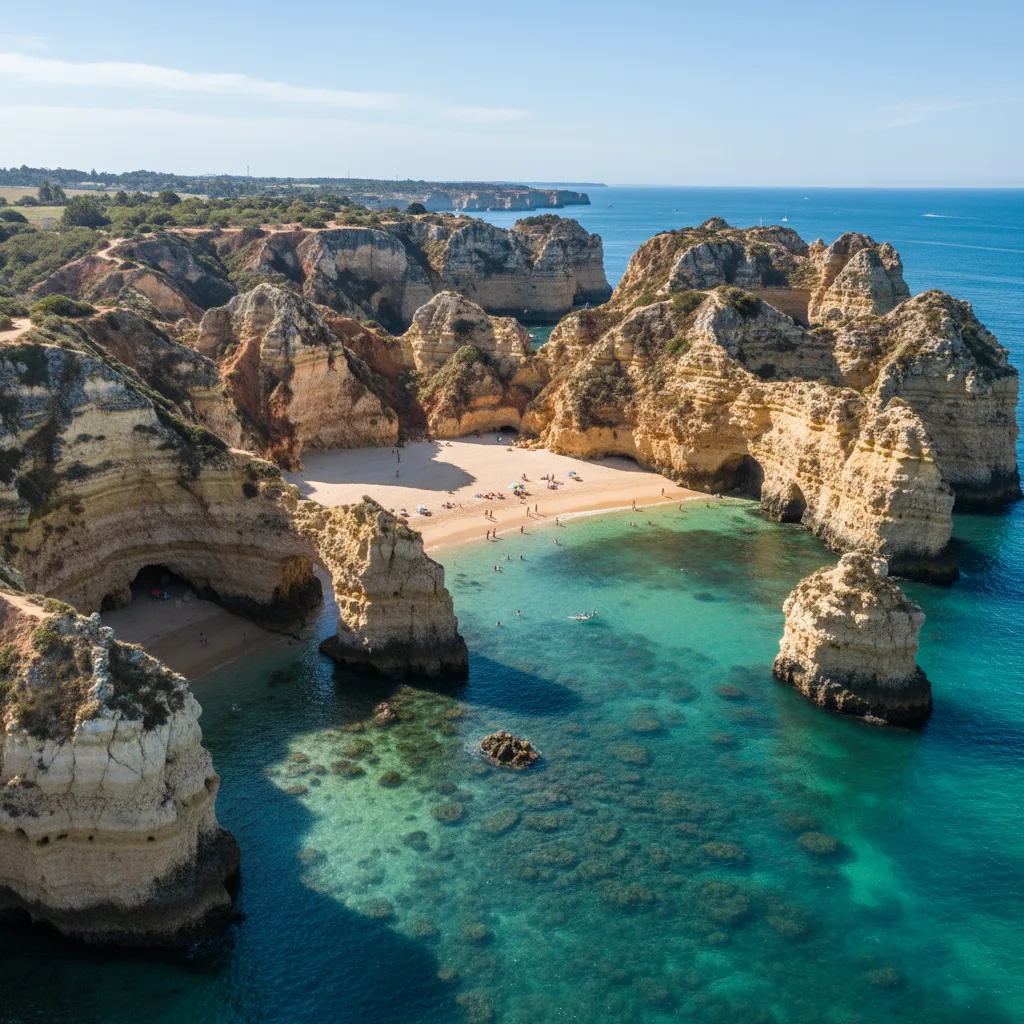
There’s a part of the Algarve that most tourists never see. While everyone heads straight to the cliff beaches of Albufeira or Carvoeiro, east of Faro lies a 60-kilometre lagoon system that is one of Europe’s most important natural spaces. It’s called Ria Formosa and was voted one of the Seven Natural Wonders of Portugal.
It’s not a beach. It’s a world apart — barrier islands, salt pans, tidal channels, salt marshes, wetlands where flamingos, herons, terns and one of the world’s largest seahorse populations live. It stretches from Faro to Cacela Velha, near the Spanish border.
The Barrier Islands of Ria Formosa
Ria Formosa is protected from the ocean by a series of sandy islands and peninsulas that act as a natural barrier. Each one has its own personality.
Ilha Deserta (Barreta) — The name says it all. It’s the only completely uninhabited island in Ria Formosa. No roads, no houses, nothing but sand, dunes, sea and the Estaminé restaurant — one of Portugal’s most isolated restaurants, with fresh seafood and a waiting list that justifies the trip. Boats leave from the Porta Nova quay in Faro.
Ilha de Faro — The closest to the city. Very popular with Faro locals in summer. Long beach, some support facilities. Access by car (there’s a road crossing the lagoon) or by boat.
Ilha de Tavira — One of the most beautiful. A long strip of sand with high dunes, calm lagoon waters on one side and open Atlantic on the other. Some basic beach support structures in summer. Ferries leave from Tavira town or the Quatro Águas quay, 2 km from town. Crossing takes a few minutes.
Ilha da Armona and Ilha da Culatra — Depart from Olhão. Culatra has a real fishing village inhabited year-round — one of the most authentic experiences you can have in the Algarve. Armona has excellent beaches and is very popular in summer. Ferries from Olhão leave from the quay on the city’s seafront.
Ilha de Cabanas — Near Tavira, accessible by boat from Cabanas de Tavira. Quieter and less well-known.
Birdwatching: Flamingos, Herons and Much More
Ria Formosa is a paradise for birdwatchers. You don’t need to be an expert to appreciate it — seeing pink flamingos in the salt pans is something that impresses anyone.
The Ludo area, between Faro and the airport, is one of the best spots for flamingos — especially during migration (spring and autumn). In the Cacela Velha area, at the eastern end of the lagoon, storks nesting is common. The purple swamphen (Porphyrio porphyrio), a bird with intense blue and purple colouring very rare in Portugal, has one of its most stable populations here.
The Marim Environmental Education Centre in Olhão has well-signposted walking trails within the Natural Park and is a good starting point for exploring the lagoon in an organised way. Entry is free.
Seahorses: The Lagoon’s Secret
Ria Formosa is home to one of the world’s largest seahorse populations. Two species live here — Hippocampus guttulatus and Hippocampus hippocampus. Scientific research has been ongoing for decades, and some local organisations do active conservation work. You’re unlikely to see a seahorse without diving, but knowing they’re there is one of those things that changes the way you look at the lagoon.
Activities in Ria Formosa
Kayaking is one of the best ways to explore the inner channels. Companies in Faro, Olhão and Tavira rent kayaks or organise guided tours. You can reach areas no motorboat can access, in total silence, with herons flying overhead.
Clam and cockle harvesting is a traditional activity in the region — you can watch the gatherers at work in the shallower parts of the lagoon during low tide. It’s not an organised tourist activity, but it’s part of the daily life of the lagoon.
There’s also a cycling route along part of the lagoon’s edge, with signposting and excellent scenery. You can hire bikes in Faro or Tavira.
Olhão: The Gateway to the Lagoon
Olhão is the gateway city to Ria Formosa in the most practical sense. The waterfront has the ferry quays for the islands, a fish and seafood market that is one of the best in the Algarve (open mornings, Tuesday to Saturday), and a very distinctive cubist architecture — the flat rooftop terraces and square white houses that recall North Africa. This influence is no coincidence: Olhão’s fishermen had intense commercial relations with Morocco for centuries.
It’s a less touristy city than Faro or Albufeira, with a more genuine daily life. Worth an afternoon, or a full weekend if you use the ferries to the islands.
Cacela Velha: The End of the World in Good Company
At the eastern end of Ria Formosa, just before the Spanish border, sits a small cluster of white houses on a promontory overlooking the lagoon. It’s called Cacela Velha and is probably the Algarve’s most beautiful village.
It has a small fortress, a church, a few restaurants, and a beach accessible by a flat-bottomed boat that makes the channel crossing (operates in summer, nominal price). The view from the cliff over the lagoon, especially in late afternoon, is extraordinary. You reach it via a secondary road from Vila Nova de Cacela, right next to the EN125.
When to Visit Ria Formosa
For birdwatching, spring (March to May) and autumn (September to November) are the best times — migratory birds pass through in great numbers. For the island beaches, summer is inevitable, but prepare for queuing ferries and busy islands in July and August.
Winter has its own beauty — the lagoon is almost deserted, flamingos are easier to spot in the salt pans, and Cacela Velha seems frozen in time. If you can choose, May or October are perfect: good weather, no crowds, nature in good condition.
Ria Formosa doesn’t compete with the cliff beaches of the central Algarve — it’s something else entirely. It’s the part of the Algarve that stays in your memory differently: quieter, more alive in the biological sense, and on a scale that reminds us how much exists beyond what the usual itineraries show.